
Three countries, three generations. India honored an English missionary on a postage stamp. The UAE commemorated two American doctors as part of its collective memory. An Asian American professional received two national awards serving a country where the gospel could not be freely preached.
What do these stories have in common?
Each brought professional skills, a servant’s heart, and a faith that said yes to God’s call. Through their work and relationships, God’s love became visible to the unreached.
Their stories illustrate three inseparable aspects of our calling: the Great Assignment to serve humanity, the Great Commandment to love our neighbors, and the Great Commission to make disciples of all nations.
God is glorified when these three come together. This is the heart of the incarnation: “the Word became flesh and made his dwelling among us” (John 1:14).
The gospel needs to be seen before it is heard.
Many unreached peoples face spiritual poverty alongside limited educational resources, inadequate healthcare, and economic hardship. These intertwined needs call for a holistic response that must begin with acts of service.
Before people are ready to hear about God’s love, they often need to see it in action. This is true whether reaching out to a friend, colleague, or neighbor, and it is even more important when crossing cultural and religious boundaries, where unfamiliar beliefs are often met with suspicion.
People may first encounter the credibility of our faith through a teacher who helps their children learn, a physician who cares for their family, or a colleague whose integrity they can trust.
The gospel is a message we proclaim not only with words but, more importantly, through our lives and our work.
“He adopted India as his country and served her people.”
In 1993, marking 200 years since William Carey arrived from England, India issued a postage stamp in his honor, noting that he “adopted India as his country and served her people.”
For more than 30 years, Carey taught Bengali and Sanskrit to British colonial officers at Fort William College. The income supported his family and ministry.
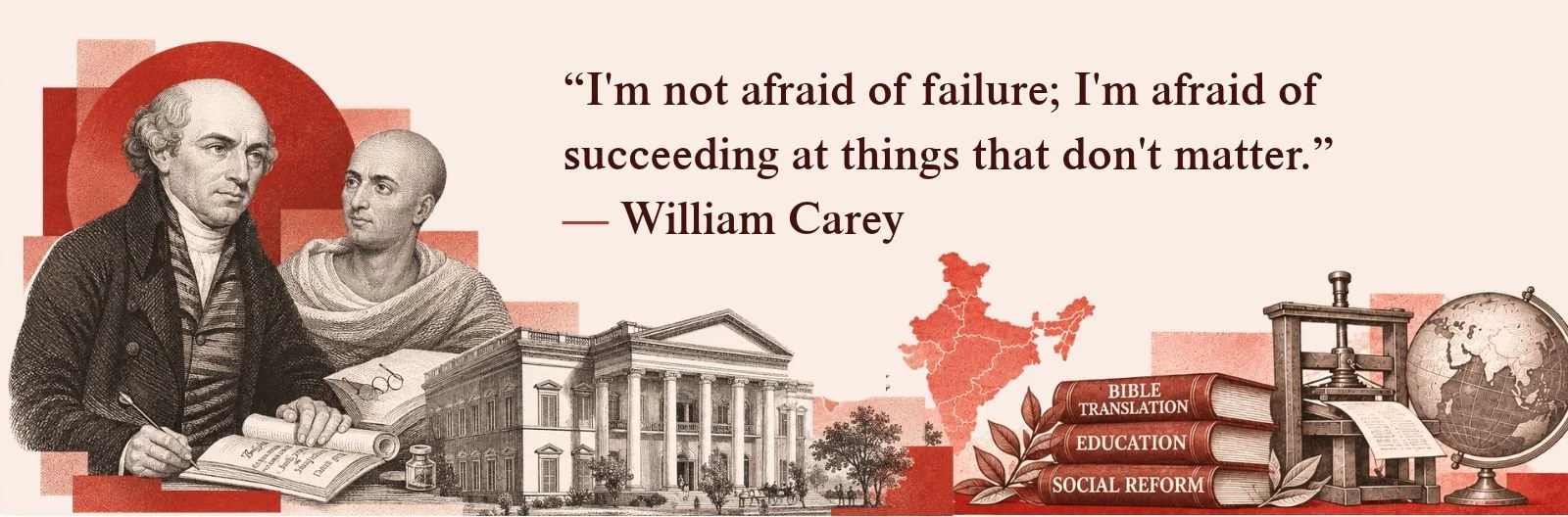
Working with local scholars, he translated and published the Bible in multiple Indian languages, helped revive indigenous languages by printing books in Indian scripts, and published the first newspaper in an Asian language, Bengali.
He planted churches, founded girls’ schools, and helped establish Serampore College, one of India’s earliest modern institutions of higher learning.
As a social reformer, Carey campaigned for 25 years against sati, which led to the ban on widow burning in India. He also helped to end the practice of burning leprosy patients alive.
Carey addressed the spiritual and social needs of those he served. His life invites us to consider how we might contribute to society’s flourishing and to make Christ known.
“They came before we discovered oil and gas.”
In 2025, UAE President Mohamed bin Zayed Al Nahyan told visiting U.S. President Donald Trump that the names of two American doctors are part of his country’s collective memory.
In 1960, infant mortality in Abu Dhabi was 50%, and maternal mortality was 33%. At the invitation of the local rulers, Drs. Pat and Marian Kennedy of California, along with their young children, arrived in the desert oasis of Al Ain to establish the emirate’s first hospital in an area where many homes lacked running water.
Three years after it was built, torrential rains destroyed the original four-room mud-brick hospital, and a fire later destroyed its aluminum-and-palm-branch replacement. For years, the family and staff endured extremely difficult living and working conditions.
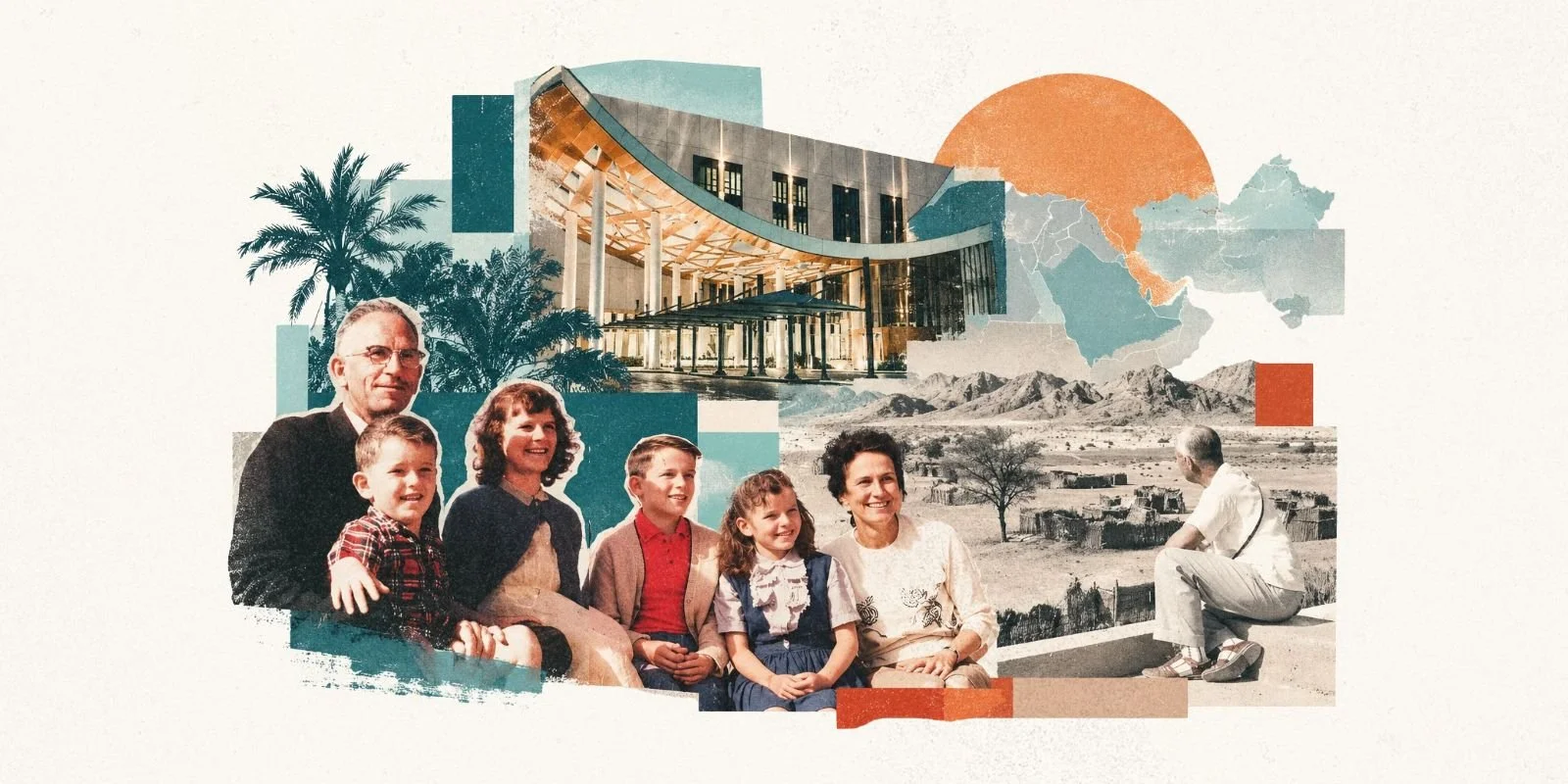
In 1961, Dr. Marian Kennedy delivered a baby boy who would become Sheikh Mohamed bin Zayed Al Nahyan, the UAE’s current president. The hospital delivered 23 children from Sheikh Zayed’s family, earning a reputation as the birthplace of the nation’s leaders.
In 2009, the royal family donated a modern facility that was named Kanad Hospital in 2019 after the Arabic pronunciation of the founders’ name.
Today, an Arabic Bible is on display in the atrium, and scripture is posted on the walls. The compound also houses the Evangelical Church of Al Ain, which serves the international Christian community.
In the hospital’s history gallery, a newspaper clipping reads, “They came before we discovered oil and gas.”
The Kennedys brought medical expertise and compassion. They endured hardship alongside those they served. Their faithfulness opened the door to a gospel witness in Al Ain that endures to this day.
Among all the countries in the Middle East, the UAE has the most tolerant policy toward Christianity.
"You are truly a servant sent by God."
DC came to America from Asia as a young boy. His Christian faith grew during his teenage years. In grad school, he began to sense God’s call to serve overseas.
His wife shared the same commitment. By the time he became a faculty member at a prestigious university, they had two children.
DC had everything every immigrant family dreams of: an excellent education, a respected career, financial stability, and a beautiful family. His parents were understandably proud.
Yet the call to serve overseas kept growing.
At 42, after years of waiting, DC found an opportunity to apply his expertise in an Asian country where the gospel could not be freely preached.
The move meant a career change, reduced financial prospects, and a contract that had to be renewed every two years. But after much prayer, the family stepped out in faith.
Eight years later, DC’s employer required him to relocate to another country. By then, he and his wife had built many relationships in the local Christian community, training Bible study and small-group leaders. They did not want to leave a growing ministry.
As they prayed, God opened a new position that allowed DC to stay. His professional relationships and experience from the previous position proved invaluable.
Over 16 years, DC’s contributions earned him two national awards. A senior colleague—not a personal friend—called his work “legendary.”
Before returning to the US, he attended a private dinner hosted by government officials he had become friends with. One of them told him, "You are truly a servant sent by God to serve our people."
Though internationally recognized for his work, DC is little known in missions circles. He simply applied his professional expertise, built relationships, faithfully served the people God placed around him, and made His love visible in his life and work as he lived out the Great Assignment, the Great Commandment, and the Great Commission.
Imagine What God Could Do Through You
Carey, the Kennedys, and DC were highly gifted. It’s easy to think, “I could never be like them.”
But we need not compare ourselves. God calls and places each of us exactly where he wants us. Our part is simply to say yes.
Even the great figures of the Bible felt unqualified: Moses, slow of speech; Gideon, the least in his family; Isaiah, a man of unclean lips; and Jeremiah, too young. Yet God met each one and said, “Do not be afraid… for I am with you.”
Imagine this: what if 100, 500, or 1,000 ordinary Christians become “mini-Careys,” offer their skills, go where they are needed, and serve wherever they can make a difference?
Picture a special ed teacher in an inner-city classroom, a software developer mentoring young students, a doctor serving in a community clinic, a business owner creating jobs, and a social worker helping low-income families, each helping an unreached community flourish while quietly bearing witness to Christ.
The Kanad story shows how such service can bless generations; DC’s, what one faithful family can do. Only a few of GLS tentmakers are as highly accomplished as DC, but many have inspiring stories of offering what they had and discovering how God used them.
The Body of Christ has many members, each with something to offer. GLS has had the privilege of walking alongside many as they answered God’s call and experienced his extraordinary grace.
So what has God placed in your hands? Your training, your experience? Where and how may He be calling you to put them at His service?
Sense God stirring something in you?
Connect with GLS at mentor@goliveserve.org for a personal conversation, and pray about your next step.